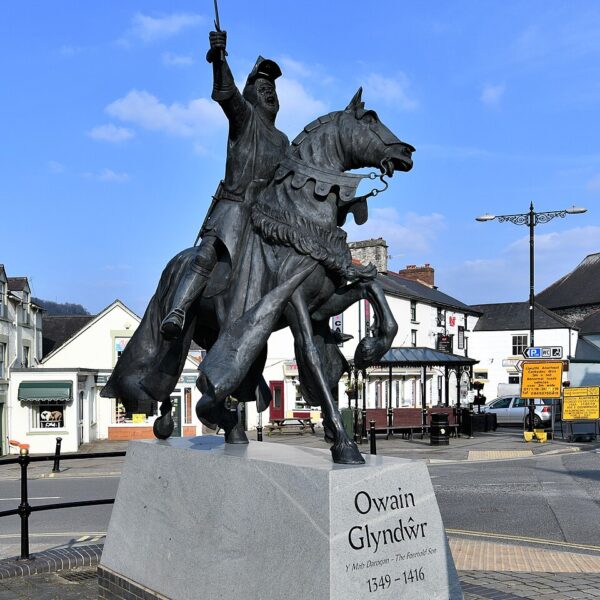
Owain Glyndŵr
Owain Glyndŵr (c. 1359 – c. 1416) was the last native Welshman to hold the title Prince of Wales, and he led the most significant Welsh uprising against English rule in the Middle Ages.

Artists impression of Glyndŵr

Owain lived at Sycharth which is just one mile from Llansilin
Glyndwr’s Timeline
Origins and upbringing
Born possible dates are 1349, 1354 or 1359 into a noble Welsh family at Glyndyfrdwy, near Corwen, Owain descended from the princes of Powys and Deheubarth. His lineage connected him to both the native Welsh aristocracy and the marcher lords who ruled border territories. Educated in England — possibly at the Inns of Court — he trained in law and served under English kings, gaining insight into both governance and military strategy.
Service and discontent
In his early adulthood, Glyndŵr fought for the English crown in campaigns against Scotland and France. Yet tensions simmered between Welsh landowners and English neighbours. A dispute with Reginald Grey of Ruthin in 1400 — over land and loyalty — became the spark that ignited the uprising. When the English crown ignored his grievances, Owain declared himself Prince of Wales, reviving the ancient title last held by Llywelyn ap Gruffudd.
The uprising begins
His declaration triggered a wave of support across Wales. Castles fell, towns were seized, and English authority faltered. Glyndŵr’s forces achieved notable victories, including the Battle of Pilleth (1402), where English troops suffered heavy losses. Captured nobles were ransomed, and his reputation soared.
Vision for an independent Wales
By 1404, Owain controlled much of Wales and convened a parliament at Machynlleth, symbolising national unity. He sought alliances with France and Scotland, envisioning a self‑governing Wales with its own church, universities, and legal system. His government issued seals and letters in Latin and French — evidence of a sophisticated diplomatic effort.
Decline and disappearance
After 1406, English counterattacks intensified. Harsh winters, scorched‑earth tactics, and internal divisions weakened the rebellion. Glyndŵr’s strongholds fell one by one. By 1412, he vanished from public view. Legends suggest he lived quietly under protection of loyal supporters, possibly near Herefordshire or in the uplands of Powys. He was never captured — a rare fate for a revolutionary leader.
Legacy and legend
Owain Glyndŵr became a symbol of Welsh resilience and independence. His banner — the golden dragon on red — still flies at cultural events and nationalist gatherings. In literature and folklore, he appears as both warrior and visionary, a figure who dreamed of a free Wales centuries before modern nationalism. His name endures in Welsh history, poetry, and place‑names, and his story continues to inspire movements for cultural revival.